




Smart spray robots are reshaping Japan’s auto coating industry.
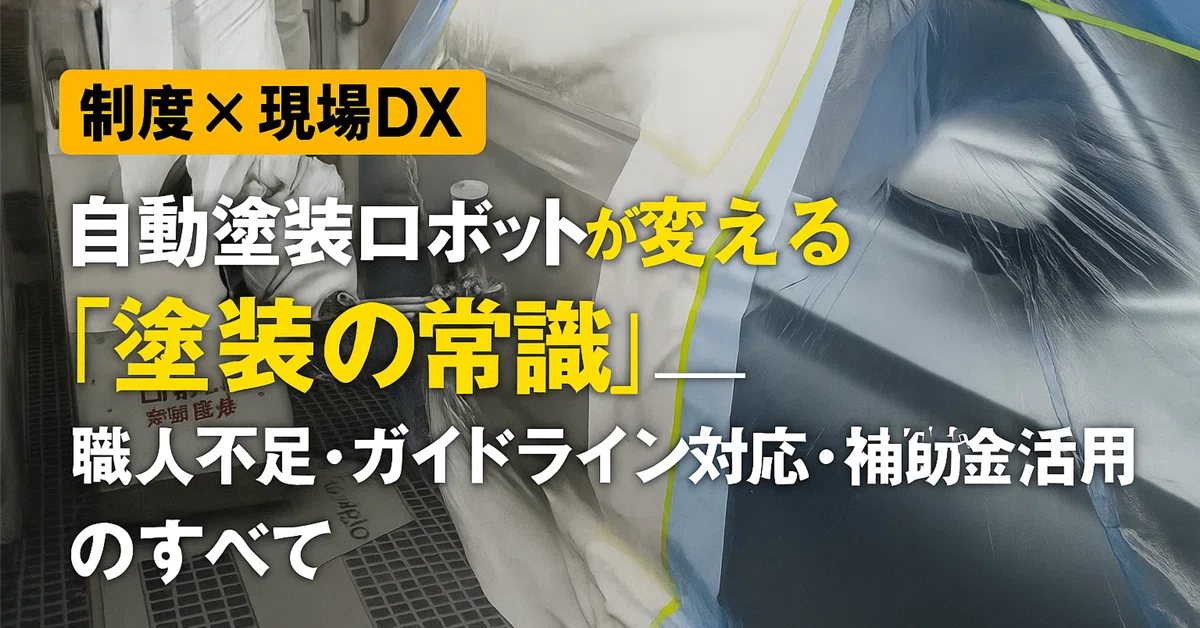
【System × On-Site DX】How Automated Coating Robots Are Changing the "Norms of Coating" – Addressing Labor Shortages, Guideline Compliance, and Maximizing Subsidy Utilization.
How the PG-90E Intelligent Bionic Spray Painting Robot is Transforming the Automotive Coating Industry
As the automotive coating industry faces the dual challenges of an aging workforce and labor shortages, the key lies not in "replacing human labor with technology," but in "creating a workplace that effectively utilizes technology." The symbol of this transformation is the XTRITON PG-90E Intelligent Bionic Spray Painting Robot.
Why are automated spray-painting robots needed today?/span>
Overcoming the challenges of labor shortages in Japan
The automotive spray-painting industry has long been regarded as the most technically labor-dependent segment— a traditional craft that relies on skilled hands and personal workmanship to make a living.
However, today the training of Japan’s next generation of technicians is failing to keep pace. As a result, technical knowledge transfer is facing a growing gap. If this situation continues, the long-term continuity and sustainability of the entire automotive spray-painting industry will be at serious risk.
At this point, automated spray-painting robots are not intended to replace skilled craftsmen, but to serve as “partners” that support and sustain productivity in the spray-painting industry.
Entering an era where quality no longer depends on human labor
Automated spray-painting robots control spray angles, distances, and material application down to the millimeter level, allowing even novice operators to achieve the same consistent, high-quality results—this is what we call “skill standardization.”
Especially in high-standard environments such as insurance repairs or corporate fleet vehicle maintenance, automated spray-painting robots demonstrate overwhelming consistency and repeatability in quality.
It is also a key enabler for achieving “information transparency.” In March 2024, Japan’s Ministry of Land, Infrastructure, Transport and Tourism released the “Guidelines for Transparency in Vehicle Body Repairs,” requiring the phased mandatory disclosure of repair process records, documentation of paint materials used, and detailed work procedures.
Image records of the repair process, certification of the paint materials used, and documentation of work procedures together establish traceability. Robotic spray painting can automatically record and reproduce the entire process, making it highly compatible with regulatory systems and a powerful tool for compliance in the automotive spray-painting industry.
Technologies Eligible for Subsidies: Barriers Within the Current System
Despite technological innovations already being in place, they continue to face “formal, system-level barriers.”
Under Japan’s SME labor-saving investment subsidy program, products must be jointly manufactured by multiple companies to be eligible for application. At present, because the XTRITON PG-90E intelligent biomimetic spray-painting robot is an imported product and is distributed by only a single authorized company in Japan, it does not fall within the scope of this program.
This clearly runs counter to the original intent of the system—to support labor-saving improvements at the operational level.
The Japan Automotive Body Repair Association (JARWA) has called for adjustments to the current system.
To address this inconsistency, JARWA has put forward the following flexible proposals for how the system could be operated:
- Having implementation track records across multiple countries and multiple companies overseas
- With clearly demonstrated evidence of its labor-saving impact and performance effectiveness
- Although there is only a single master distributor in Japan, the product is supported by multiple sales channels
They urge policymakers not to exclude innovative technologies solely due to “formal documentation requirements,” but instead to genuinely respond to industry needs and enhance the practical effectiveness and on-site value of policy measures.
Witness the innovative technology of XTRITON PG-90E firsthand
From “painting operations” to “institutional assurance”
Automated spray-painting robots are no longer a vision of the future, but have become standard equipment in the automotive spray-painting industry:
- Resolving technological dependency and bridging the gap in skill transfer
- Stabilizing automotive spray-painting quality
- Enhancing alignment with institutional and regulatory requirements
- Improving profitability through labor savings
As long as small and medium-sized enterprises can flexibly adopt intelligent biomimetic spray-painting robots, the automotive spray-painting industry will no longer be a traditional labor-dependent trade, but can transform into a new, modern industry driven by AI intelligence.
(Article excerpted from an anonymous AI journalist / Minami Yōsetsu/ Automotive Industry Column)
Article Source:https://note.com/id_yoshino/n/n88d832d231f0
If there are any errors or potential copyright infringements, please contact us and we will remove the content. Thank you.